Amputee Rehabilitation & Prosthetic Training
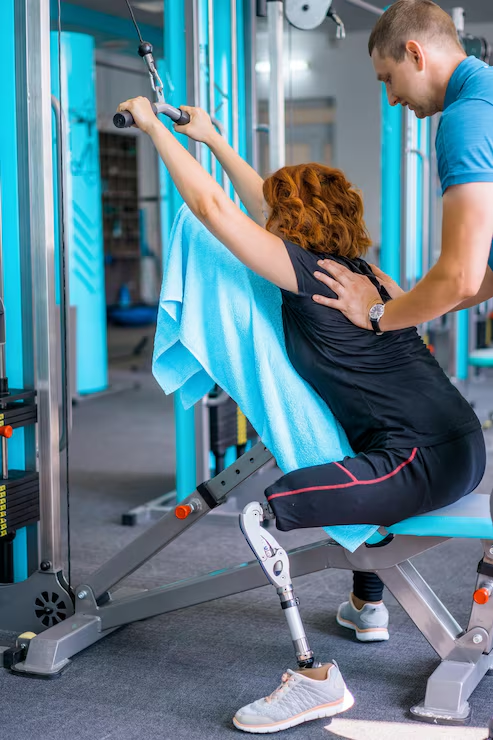
Amputee Rehabilitation & Prosthetic Training in Thousand Oaks, CA
Life after amputation presents real physical challenges but with structured, expert rehabilitation, the large majority of amputees achieve a high level of independence and functional activity. At Reform Physical Therapy in Thousand Oaks, our amputee rehabilitation program is led by our team: Sejal, Heeren, Omri, Amanda, Taryn, Karen, Lauren, Auzar, and Nicole.
We coordinate closely with your prosthetist, vascular surgeon, and referring physician to provide a fully connected rehabilitation program. Serving patients from Thousand Oaks, Camarillo, Newbury Park, Oxnard, and across Ventura County.
What Is Amputee Rehabilitation?
Amputee rehabilitation is a multiphase PT program covering residual limb conditioning, prosthetic candidacy assessment, prosthetic fitting preparation, gait training, fall prevention, and functional reintegration for upper and lower extremity amputees following traumatic or dysvascular amputation.
MEDICAL DISCLAIMER: The information on this page is for general educational purposes only. It does not constitute medical advice and is not a substitute for professional diagnosis, treatment, or evaluation by a licensed healthcare provider. If you are experiencing a medical emergency, call 911 immediately.
Signs You May Benefit from Amputee Rehabilitation
Pelvic floor dysfunction can affect bladder, bowel, sexual, and pelvic function. Common symptoms include:
- You have recently undergone a lower or upper extremity amputation and have been referred for outpatient rehabilitation
- You are preparing for prosthetic fitting and need residual limb shaping and conditioning
- You have received a prosthesis but are not confident with donning, doffing, or functional use
- You have difficulty with balance, gait quality, stairs, or uneven terrain while using your prosthesis
- You experience phantom limb pain affecting your sleep, mood, or rehabilitation
- You are a long-standing prosthetic user whose function, device, or activity level has changed
Conditions We Treat
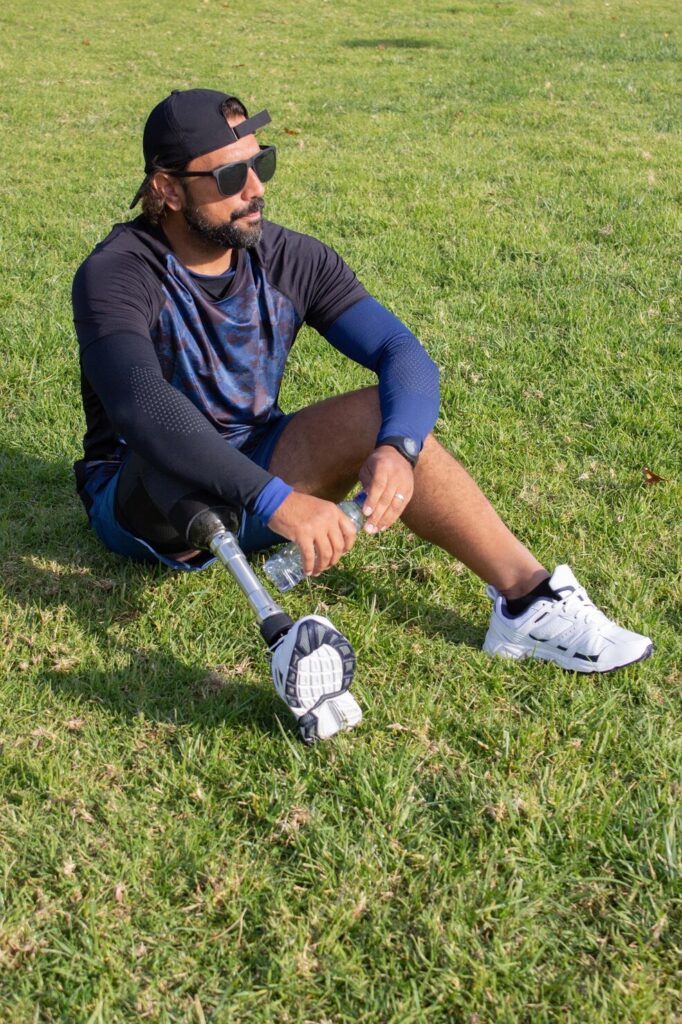
- Transtibial (below-knee) amputation all causes
- Transfemoral (above-knee) amputation
- Partial foot and toe amputations
- Transradial (below-elbow) and transhumeral (above-elbow) amputation
- Bilateral lower extremity amputation
- Dysvascular amputation from diabetes or peripheral vascular disease
- Traumatic amputation recovery
- Phantom limb pain management
- Residual limb pain and skin breakdown prevention
Our Approach at Reform Physical Therapy
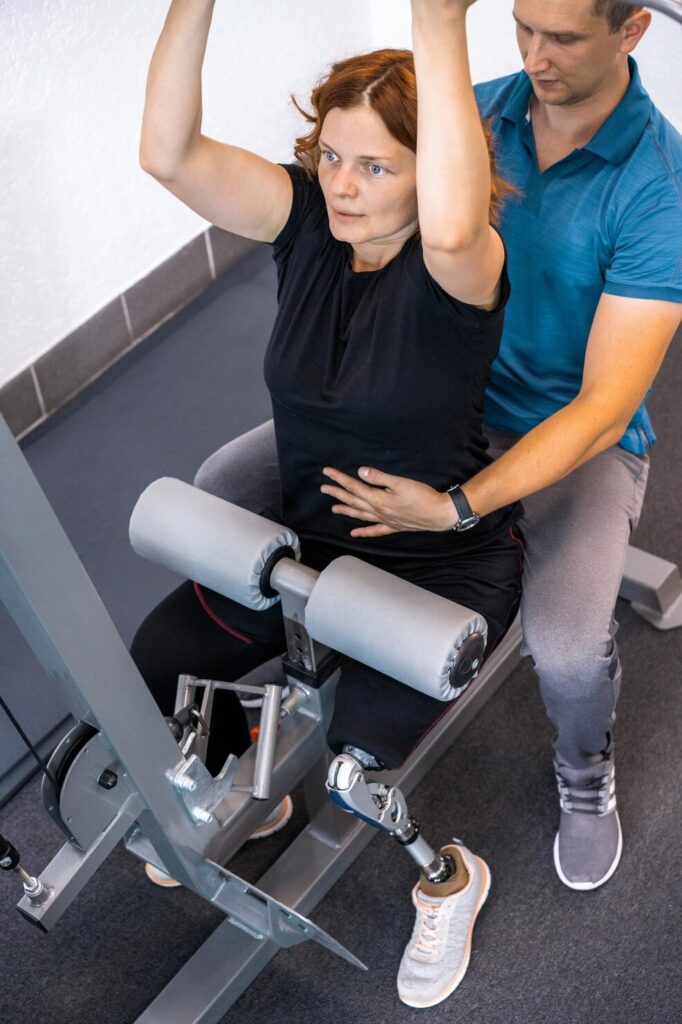
Pre-prosthetic rehabilitation begins 2 to 4 weeks post-surgery and focuses on residual limb shaping using compression wrapping or shrinker socks, edema management, skin integrity monitoring, and upper body and core strengthening for transfers and mobility.
Prosthetic candidacy is assessed using the K-level classification system (K0 through K4), which categorizes rehabilitation potential from non-ambulatory (K0) through community ambulation with the ability to exceed basic walking demands (K4). Your K-level is determined in coordination with your physician and prosthetist and directly determines appropriate prosthetic componentry.
Prosthetic training begins in the parallel bars, progressing to open-surface gait, outdoor terrain, stairs, ramps, and return to community ambulation. Fall prevention strategies and safety monitoring using a gait belt are integrated throughout all weight-bearing phases.
Phantom limb pain is addressed using mirror therapy, graded motor imagery, and desensitization techniques all of which have clinical evidence supporting reduction in phantom pain intensity and frequency.
We coordinate regular communication with your prosthetist. Gait deviations identified in PT sessions often require socket fit or alignment adjustments we flag these directly so device changes and therapy progression stay synchronized.
Clinical Tools & Assessment: Assessment tools include: K-level classification (K0-K4), residual limb circumference measurement (shaping progress tracking), 6-Minute Walk Test (6MWT), Amputee Mobility Predictor (AMP), L-Test, 10-Meter Walk Test, Timed Up and Go (TUG), and phantom limb pain visual analog scale (VAS).
Why Choose Reform PT for Amputee Rehab in
Thousand Oaks?
Our team brings 20+ years of clinical experience across the full spectrum of care settings where amputee rehabilitation occurs from acute hospital through outpatient. We coordinate with your prosthetic team and surgical providers to keep your program unified. Serving Thousand Oaks, Camarillo, Newbury Park, Oxnard, and across Ventura County.
Frequently Asked Questions
Amputee rehab is a multiphase program covering residual limb conditioning, K-level candidacy assessment, prosthetic training, balance and gait retraining, fall prevention, and return to functional daily activities. It begins post-surgery and continues through outpatient PT until mobility goals are reached.
PT typically begins within 2 to 5 days of surgery in the hospital, focusing on positioning, edema management, and strength. Outpatient rehab starts 2 to 4 weeks post-surgery once the wound is stable enough for prosthetic preparation activities.
Most patients need 3 to 6 months of outpatient PT for functional prosthetic use in daily life. Bilateral and above-knee amputees typically need longer programs. Timeline depends on amputation level, overall health, K-level, and activity goals.
Yes. Mirror therapy, graded motor imagery, and desensitization techniques have clinical evidence supporting reduction in phantom limb pain intensity and frequency. These are incorporated alongside functional mobility training from early in the rehab program.
Yes. We communicate regularly with your prosthetist to coordinate device adjustments with therapy progression. Gait deviations identified in PT often require socket or alignment changes, which we flag directly so your device and your rehab stay synchronized.
Yes. Amputee PT is covered under Medicare Part B and most commercial insurance plans when medically necessary. Coverage for prosthetic training varies by plan. Our billing team verifies your specific benefits before your first session.
Reform Physical Therapy provides individualized amputee rehab and prosthetic training in Thousand Oaks for patients from Camarillo, Newbury Park, Oxnard, and across Ventura County. We coordinate with your surgical team and prosthetist for a fully connected program.
Related Services at Reform Physical Therapy
Ready to get started?
Call Reform Physical Therapy in Thousand Oaks or request your evaluation online. Most insurance plans accepted. Same-week appointments typically available.